Thursday, March 19, 2026
PPWR & Luxury Packaging: Harmonizing Prestige with Sustainability
LUXE PACK Monaco

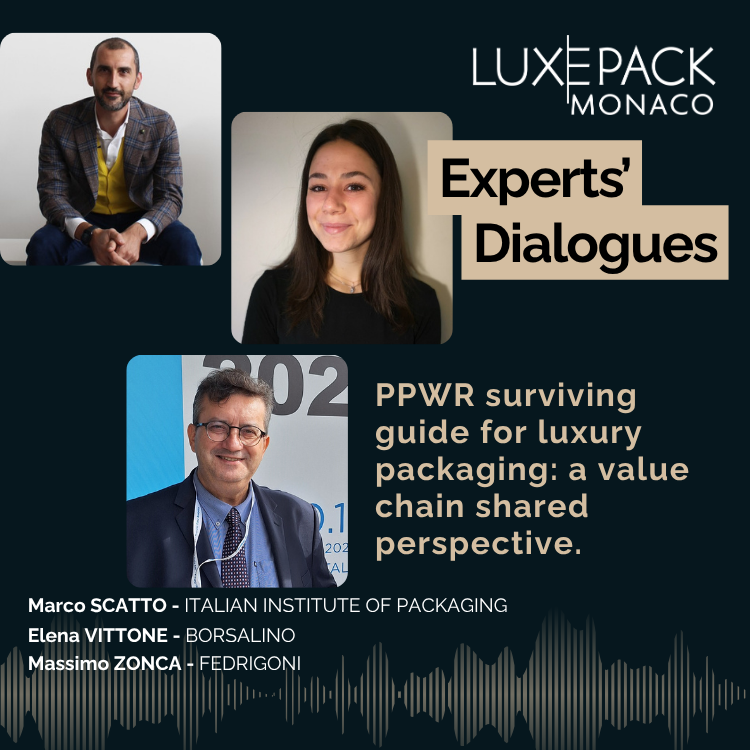
In an era where luxury packaging PPWR compliance is no longer optional, brands face the dual challenge of preserving prestige while meeting stringent environmental mandates. The new European Packaging and Packaging Waste Regulation (PPWR) compels a radical reevaluation of materials, design, and end-of-life strategies. At LUXE PACK Monaco, experts from the Italian Institute of Packaging and Fedrigoni unveiled a collaborative framework designed to guide raw-material producers and luxury houses toward a future that is both desirable and legally resilient.
The transition represents what Marco Scatto, coordinator of the Luxury Packaging Commission at the Italian Institute of Packaging, calls a "Copernican revolution." Sustainability is no longer a peripheral exception or a marketing "plus"; it is becoming the core operational norm. To navigate this, a ten-month intensive collaboration with leading global maisons resulted in an open-source environmental management guideline. This document prioritizes transparency and eco-design over rigid, restrictive rules, integrating the latest European directives to ensure that heritage craftsmanship can thrive within a circular framework. The goal is to move beyond the fear of regulation and view it as a blueprint for long-term brand resilience.

The Regulatory Landscape: Navigating 2030 Targets
The PPWR introduces mandatory recyclability criteria that will be phased in by 2030. For luxury brands, this means that every component—from the outer box to the internal fitment must be designed for high-quality recycling. This involves a shift away from complex multi-material laminates that often "clog" recycling streams. The regulation also targets "over-packaging," mandating a reduction in empty space ratios, which directly impacts the traditional "large box for a small bottle" aesthetic used to convey value in the luxury sector.
Supplier Innovations: Solving the Sustainable Equation
Suppliers are at the front lines of this transformation, balancing compliance with sensory excellence. Massimo Zonka of Fedrigoni introduced a six-pillar "sustainable equation" to guide the production of sustainable packaging. This framework emphasizes:
1. Material Innovation: Developing renewable, recyclable, or compostable substrates that mimic the touch of silk or suede.
2. Transparency:Full traceability of fiber origin to build consumer trust in "green" claims.
3. Social Commitment: Ethical procurement that supports local communities.
4. Anticipating Standards: Proactive R&D that tests materials against 2035 standards today.
5. End-of-Life Strategy: Ensuring that even the most luxurious paper can be repulped without toxic residues.
6. Resource Optimization: Implementing low-impact manufacturing processes that reduce water and energy intensity.
Case Study: The Reconstruction of the Luxury Box
The most powerful proof of this shift is the "Luxury Box Project." Six companies collaborated to reimagine a traditional high-end gift set. The original design relied heavily on magnets for closure, plastic lamination for "soft touch" effects, and internal plastic trays for product security.
The reimagined version achieved a mono-material construction with zero compromise on the unboxing experience:
· Material Reduction: A 20% overall reduction in weight through structural engineering.
· Plastic Replacement: Using biopolymer-laminated high-sustainability paper instead of traditional plastic film.
· Fiber Inserts: Replacing plastic trays with molded fiber compartments that offer the same protective cushioning.
· Magnetic-Free Closure: Utilizing a luxurious paper-based tape and hinge system that allows the entire box to be recycled in the paper stream. The result? A 50% reduction in carbon footprint and a logistics chain that can be flattened for more efficient shipping.
Brand Heritage Meets Environmental Responsibility
For heritage brands like Borsalino or legendary fragrance houses, packaging is a vital component of the brand’s DNA. Elena Vittone highlighted that at premium price points, customers now expect beauty to align with ethical values. However, she warned against a "one-size-fits-all" approach. Guidelines must remain flexible enough to support never constrain the unique identity of each maison. Credibility in this new era is derived not from labels alone, but from an expert-driven, collaborative process that respects the emotional value of the object.
The Technical Challenge of Recyclability at Scale
By 2035, the EU will require packaging to be "recycled at scale," meaning the infrastructure must exist to process it effectively. This puts pressure on the luxury industry to simplify its "material palette." We are seeing a massive trend toward:
· Cellulosic Innovation: Papers that provide barrier properties without aluminum or plastic layers.
· Aluminum Monomaterials: For tubes and caps that are infinitely recyclable.
· Refill Rituals: Designing the primary container (the "prestige" element) for a 10-year lifespan, while the secondary packaging becomes a lightweight, fully recyclable refill.
A New Era of Refinement
The dawn of the PPWR ushers in a delicate equilibrium between emotion and reason. Navigating this landscape requires cross-value-chain collaboration among designers, material specialists, and brand teams. The current guidelines are more than a compliance tool; they are a springboard for innovation. By embracing circularity and eco-design, the luxury sector can redefine refinement, ensuring that the pinnacle of elegance remains both aspirational and enduring for tomorrow’s discerning clientele. The future of luxury is not just about the object itself, but about the regenerative story it tells from the forest to the recycling center.