Saturday, March 21, 2026
Navigating Luxury Packaging Regulations: Global Challenges & Opportunities
LUXE PACK Monaco

The luxury packaging regulation landscape is undergoing a seismic shift, forcing prestigious houses to balance stringent compliance requirements with the imperative to uphold premium brand identity. From Europe’s groundbreaking Packaging and Packaging Waste Regulation (PPWR) to the fragmented Extended Producer Responsibility (EPR) schemes in the United States, stakeholders face a rising tide of complexity. At LUXE PACK Monaco, industry leaders dissected these trends, revealing how these mandates can act as both a hurdle and a powerful catalyst for sustainable packaging innovation.
Europe’s new PPWR represents more than just a minor adjustment; it is a complete reconfiguration of the regulatory landscape. Unlike previous directives, the PPWR is directly applicable across all EU member states, prescribing specific design-for-recycling targets and strict packaging bans. Carlo Pirone, Secretary General of FEVE, describes it as a "living animal," noting that numerous implementing acts and guidance documents are still pending. This lack of immediate clarity challenges long-term industrial planning, yet it forces a proactive stance from the world's leading luxury players.
“PPWR is a living animal, with numerous delegated acts yet to come, unclear interpretations, and delayed Commission guidance.” —Carlo PIRRONE, Secretary General, FEVE.
The Global Fragmentation Challenge: EU, US, and Asia
While Europe moves toward harmonization, the rest of the world remains a mosaic of conflicting rules. In the United States, EPR schemes are being enacted on a state-by-state basis. Leo Leroy of LVMH highlights that with at least seven states currently moving in different directions, brands are struggling with differing scopes, definitions, and deadlines. This fragmentation generates significant administrative costs and often stalls product launches.
In the Asian markets, the challenge is twofold. Olaf Zahra of Toly Group points out that while regulatory awareness is lower, consumer focus remains heavily skewed toward “premiumization” and aesthetics rather than eco-conscience. However, strict "excessive packaging" bans in China and South Korea are already forcing brands to simplify their designs, reducing void ratios and material layers. For global houses, the dilemma is clear: maintain a single global design with heavy administrative burdens, or fragment the supply chain into costly local adaptations.
Transforming Internal Dynamics and Design Strategies
Regulatory pressure is fundamentally reshaping corporate structures. Compliance is no longer a niche legal concern; it now spans purchasing, R&D, design, and marketing. At LVMH, centralized regulatory support now engages design teams from the very inception of a project to prevent later-stage innovations from being stifled by non-compliance. Similarly, Toly Group has built a dedicated regulatory unit to monitor global legislation and guide clients through the minefield of recyclability assessments.
“Marketing teams question immediate changes to packaging that is currently compliant, stifling innovation.” — Leo Leroy, LVMH.
This internal pivot is driving a shift toward sustainable packaging innovation. Instead of focusing solely on the unboxing experience, innovation teams are now concentrating on:
- Mono-material solutions: Redesigning compacts and closures to ensure they fit within single-stream recycling.
- PCR Integration: Validating post-consumer recycled content, which introduces material variability and demands higher machine precision.
- Material Substitution: Moving beyond traditional plastics into alternative, lower-impact substrates.
Regulation as a Catalyst for Industry Collaboration
Despite the friction, many experts view the current regulatory wave as "innovation capital." Judith Fiedler, an independent consultant, argues that because the PPWR focuses primarily on materials, it leaves ample scope for creative design solutions. This environment is fostering unprecedented cross-sector collaboration. Brands, suppliers, and recyclers are now co-creating design-for-recycling criteria through platforms like SETI and SPICE.
“Regulation is innovation capital, not just a constraint—PPWR focuses on materials, leaving ample scope for creative design solutions.” — Judith Fiedler, Independent Consultant.
The energy crisis and cost efficiency drivers have already birthed lightweight glass and optimized logistics, but the PPWR provides the legal framework to scale these successes. Carlo Pirone calls for "good regulation"—stable, future-proof, and oriented toward competitiveness—to ensure that the industry does not merely react to trade barriers but actively shapes a more resilient market.
Looking Ahead to 2035: The Future of Luxury Identity
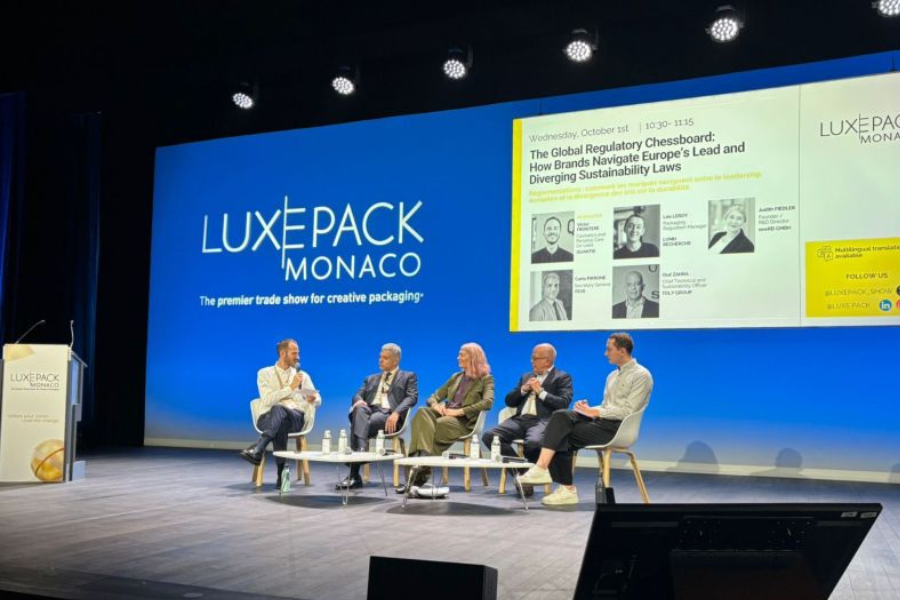
The industry has mapped critical milestones for the next decade. By 2028, design-for-recycling criteria will redefine which packaging is even eligible for the market. By 2030, "recycling at scale" will be the mandatory standard. As we look toward 2035, the panel at LUXE PACK Monaco predicted a future where packaging integrates into a broader, connected product experience.
Transparency through connected packaging will inform consumers about origins, use, and end-of-life disposal. While the mass market may shift toward more undifferentiated formats, luxury brands must fight to ensure that packaging remains an art form. As the sector moves toward "super premium" dosing devices and high-tech refill rituals, the challenge will be to ensure that sustainability does not lead to commoditization.
Regulation as a Strategic Compass
The Luxe Pack Monaco panel underscored a historic turning point. Global luxury packaging regulation is no longer just an administrative hurdle; it is a strategic compass. By embracing collaboration, technical innovation, and proactive policy engagement, the luxury value chain can leverage these mandates to build a more responsible and distinctive future. Those who succeed will be the brands that view compliance not as a finish line, but as the foundation for a new era of circular elegance.