Monday, March 16, 2026
How Chinese Aesthetics Redefine Global Luxury Standards
LUXE PACK Monaco

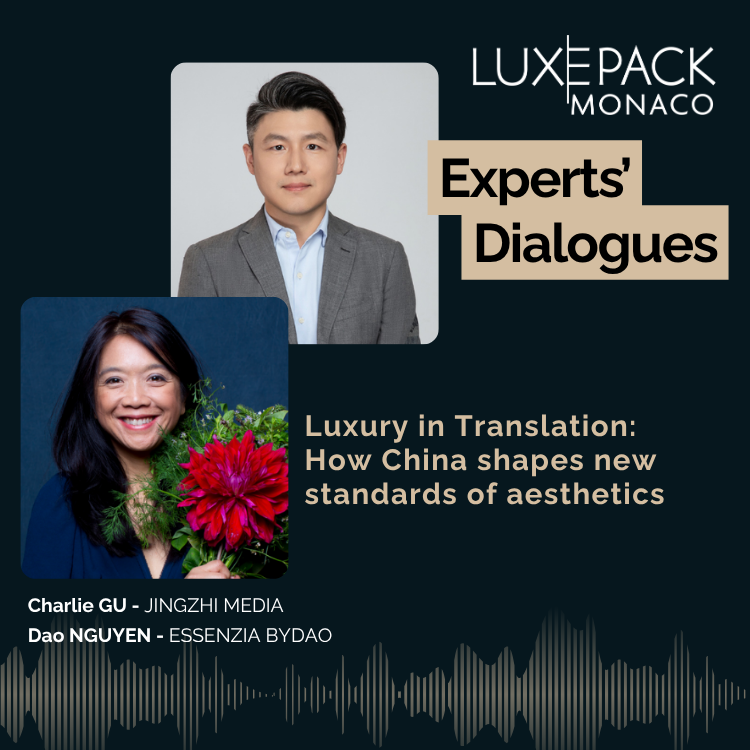
The rise of Chinese aesthetics in the luxury sector is more than a passing trend, it is a fundamental paradigm shift. At LUXE PACK Monaco, experts Daoud Nguyen and Charlie Zhou explored how China’s rich design heritage and contemporary creativity now set the pace for global excellence. Understanding this evolution is vital for brands aiming to resonate authentically with discerning consumers and stay ahead in an increasingly competitive global market.
China’s aesthetic journey spans the flamboyant extravagance of the Tang Dynasty to the subdued elegance of the Song era. This duality makes defining a single "look" difficult, yet the common thread remains a philosophy of balance and constraint rooted in Yin and Yang. This principle manifests in product design where seemingly simple forms conceal layers of meaning, echoing the proverb of traveling “10,000 miles to give someone a feather,” where the thoughtfulness of the gesture outweighs the material value.
To navigate this landscape, brands must decode the historical foundations that inform the Guochao trend:
· The Tang Legacy: Characterized by bold colors and flamboyant motifs, signifying celebration and social status. This era represents the "maximalist" side of Chinese luxury, often associated with gold, vibrant reds, and intricate patterns that demand attention.
· The Song Influence: Defined by minimal palettes of light grays and blues, underscoring subtlety, introspection, and a "less is more" philosophy. This era is the precursor to modern minimalism, where the quality of the glaze or the curve of a ceramic piece speaks louder than any ornament.
These contrasting legacies inform modern designers who strive for harmony between overt display and profound symbolism. As the Chinese market matures, the shift toward the "Song" aesthetic of quiet luxury is becoming more pronounced among the ultra-high-net-worth individuals.
Pioneers of Modern Chinese Luxury: From Heritage to Avant-Garde
New brands are channeling this heritage into fresh, forward-looking identities, drawing significant investment from global players like L’Oréal. T-Summer, founded in 2017, coined the term « modern contemporary oriental » to describe its look. Its packaging uses discreet cues, material textures and muted tones, that reveal Chinese origins only upon closer inspection.
This restrained approach aligns with the tastes of younger buyers who favor authenticity over overt cultural clichés. For these consumers, the luxury experience is found in the "discovery" of the cultural link rather than having it shouted at them through branding.
Similarly, the brand Document has transitioned from a « Zen cool » aesthetic to a proud declaration of its roots. By its seventh collection, Document centered its identity on four traditional ingredients oud, sandalwood, ambergris, and musk (Chen tan long shu) and revived coil incense as a creative perfumery tool.
Symbolism and Design Language: The Geometry of Meaning
Beyond materials, Chinese aesthetics embeds symbolic meaning in every shape. Western designers must grasp that forms are never purely decorative. For instance, the knot-logo used by Document serves as a symbol of luck and longevity, fusing language and visual identity into a single, cohesive mark. Similarly, the octagonal bottles found in recent high-end launches evoke the baguagrid and classical garden windows, symbolizing the dialogue between permanence and transformation.
Charlie Zhou notes that while Western design often prioritizes ergonomics and functionality, Eastern design prioritizes connotation and spatial harmony. Round forms suggest completeness, unity, and the celestial, while square shapes imply solidity, the earth, and human-made structures.
The combination of both a square bottle with a round cap symbolizes the union of heaven and earth, a potent message for a luxury consumer.
· Document’s knot-logo: A symbol of luck, seamlessly fusing language and visual identity.
· Two Define’s octagonal bottle: Evokes the bagua grid and classical garden windows, symbolizing the dialogue between permanence and transformation.
· The 26-faceted cap: Inspired by an ancient general’s seal, it suggests the multifaceted nature of personal identity in a digital age.
Understanding these nuances is the difference between a product that looks "oriental" and one that feels "authentic." When Cartier launched its popular Balloon Bleu watch, its roundness resonated deeply with Chinese consumers not just because it was beautiful, but because it connoted "completeness" and "unity".
The Imperative of Cultural Agility
Superficial homage to Chinese culture such as simply putting a dragon on a box often backfires. Cultural agility the ability to decode color connotations, shape symbolism, and historical references is now a mandatory skill for Western creatives. This methodology involves translating implicit cultural messages into cohesive brand narratives that resonate with ideogram-based cultures where every element carries layered meaning.
Dao NGUYEN “smart design” workshops train creatives to translate these implicit messages. This methodology extends beyond China to other ideogram-based cultures like Japan and Korea, where the relationship between negative space and the main subject is a critical design element. Conversely, Chinese brands expanding globally must distill their rich stories into universally engaging touchpoints. The burden is on the brand to find elements that resonate across borders rather than expecting instant cross-cultural comprehension.
“It’s really hard to pin down… what is Chinese aesthetics? Because it’s so diverse.” — Charlie GU.
China’s Enduring Influence on the Global Stage
China no longer follows; it leads. From heritage-inspired pioneers to the deep symbolism behind every curve and hue, the impact of these traditions is reshaping luxury packaging and branding worldwide. The key lesson for any brand is to cultivate a deeper understanding of these codes, embedding authentic meaning rather than surface decoration. By doing so, the industry moves toward a future where the pinnacle of elegance is inherently global, thoughtful, and enduring. As the "Guochao" movement continues to evolve, it will likely influence not just the aesthetics of luxury, but the very definition of what it means to be a "prestige" brand in the 21st century.